Top 10 Python PDF Generator Libraries: Complete Guide for Developers (2026)
Python is one of the most popular languages for document automation. Whether you're generating invoices, certificates, or complex reports, choosing the right library is critical for performance and maintainability.
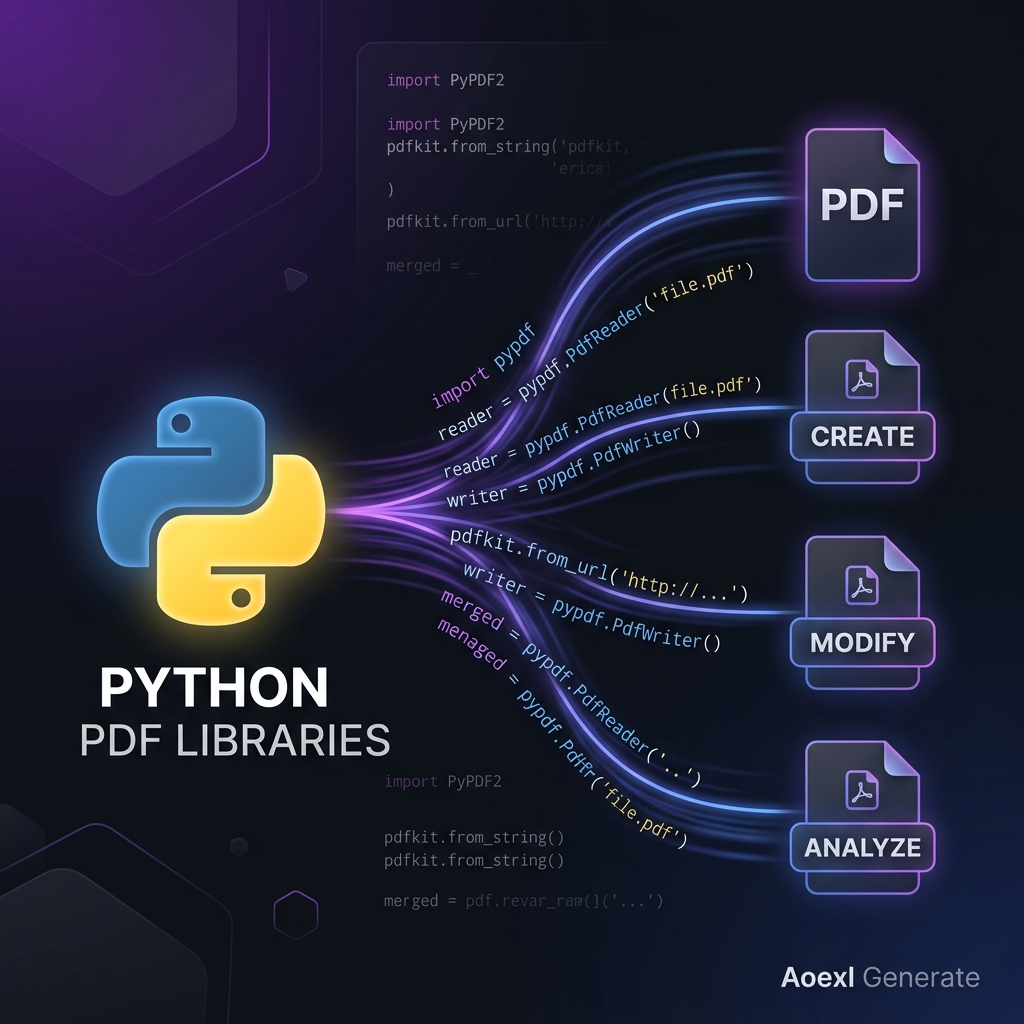
In this guide, we compare the top 10 Python PDF libraries for 2026, categorized by their rendering approach.
The Landscape: Canvas vs. HTML-to-PDF vs. Cloud APIs
1. Canvas-Based (Maximum Control)
These libraries require you to position text and shapes using coordinates (x, y). They are verbose but offer pixel-perfect control.
- ReportLab: The industry standard for heavy-duty reporting and charts.
- FPDF2: A lightweight, pure-Python choice for simple documents.
- borb: A modern library with a high-level layout engine and barcode support.
2. HTML-to-PDF (Developer Friendly)
These tools render HTML and CSS into a PDF. This is often faster if you already have a web-based design.
- WeasyPrint: A robust, pure-Python renderer that supports modern CSS.
- PDFKit: A wrapper around
wkhtmltopdf(requires an external binary). - Playwright: Uses a headless browser to "print" complex JavaScript-heavy pages to PDF.
3. Enterprise Cloud APIs (Scalable & Feature-Rich)
For professional applications that need enterprise features like digital signatures, OCR, and complex form filling without local dependencies.
- Aoexl Generate API: A powerful REST API that handles HTML-to-PDF, Office-to-PDF, and advanced document processing.
A Detailed Look at the Top Contenders
1. Aoexl Generate API (Cloud)
The Aoexl Generate API is the premium choice for businesses that need more than just "text on a page." It handles the heavy lifting of PDF generation and manipulation in a secure cloud environment.
Why choose Aoexl?
- No Local Dependencies: No need to manage fonts, browser binaries, or low-level C libraries on your server.
- Multi-Format Support: Generate PDFs from HTML, Office documents (Word, Excel), or Markdown.
- Advanced Features: Built-in support for digital signatures, OCR, and PDF/A compliance.
Example Code:
import requests
import json

# Send the request to Aoexl Generate API
response = requests.post(
    'https://api.aoexl.com/generate',
    headers={'Authorization': 'Bearer {YOUR_API_KEY}'},
    files={'index.html': open('index.html', 'rb')},
    data={'options': json.dumps({'format': 'A4'})}
)

if response.status_code == 200:
    with open('result.pdf', 'wb') as f:
        f.write(response.content)
2. ReportLab (Open Source)
ReportLab is the workhorse of the Python PDF world. It’s perfect for generating hundreds of thousands of documents with complex charts.
Best for: Financial reports, barcoded labels, and data-driven brochures.
3. WeasyPrint (Open Source)
If you have a beautiful HTML/CSS template and want to turn it into a PDF without leaving the Python ecosystem, WeasyPrint is an excellent choice.
Best for: Receipts, invoices, and web-native documentation.
Comparison Table
| Feature | Aoexl Generate | ReportLab | WeasyPrint |
|---|---|---|---|
| Approach | Cloud API | Canvas (Code) | HTML/CSS |
| Effort | Low | High | Medium |
| Charts | Yes | Yes (Native) | Yes (via CSS) |
| Signatures | Professional / Digital | Basic | No |
| Office-to-PDF | Yes | No | No |
| Maintenance | None | High | Medium |
Decision Guide: Which Library Should You Use?
- Use ReportLab if you are building an offline standalone tool that needs to draw complex vector charts from scratch.
- Use WeasyPrint if you are a web developer with an existing CSS design and a small volume of documents.
- Use the Aoexl API if you are building a production SaaS app that requires high scalability, professional signing capabilities, or needs to convert existing Office files to PDF.